All your secure bases are belong to us 🤖⛺️.
When does structure give us a greater sense of freedom? When does it constrain or contain us instead?
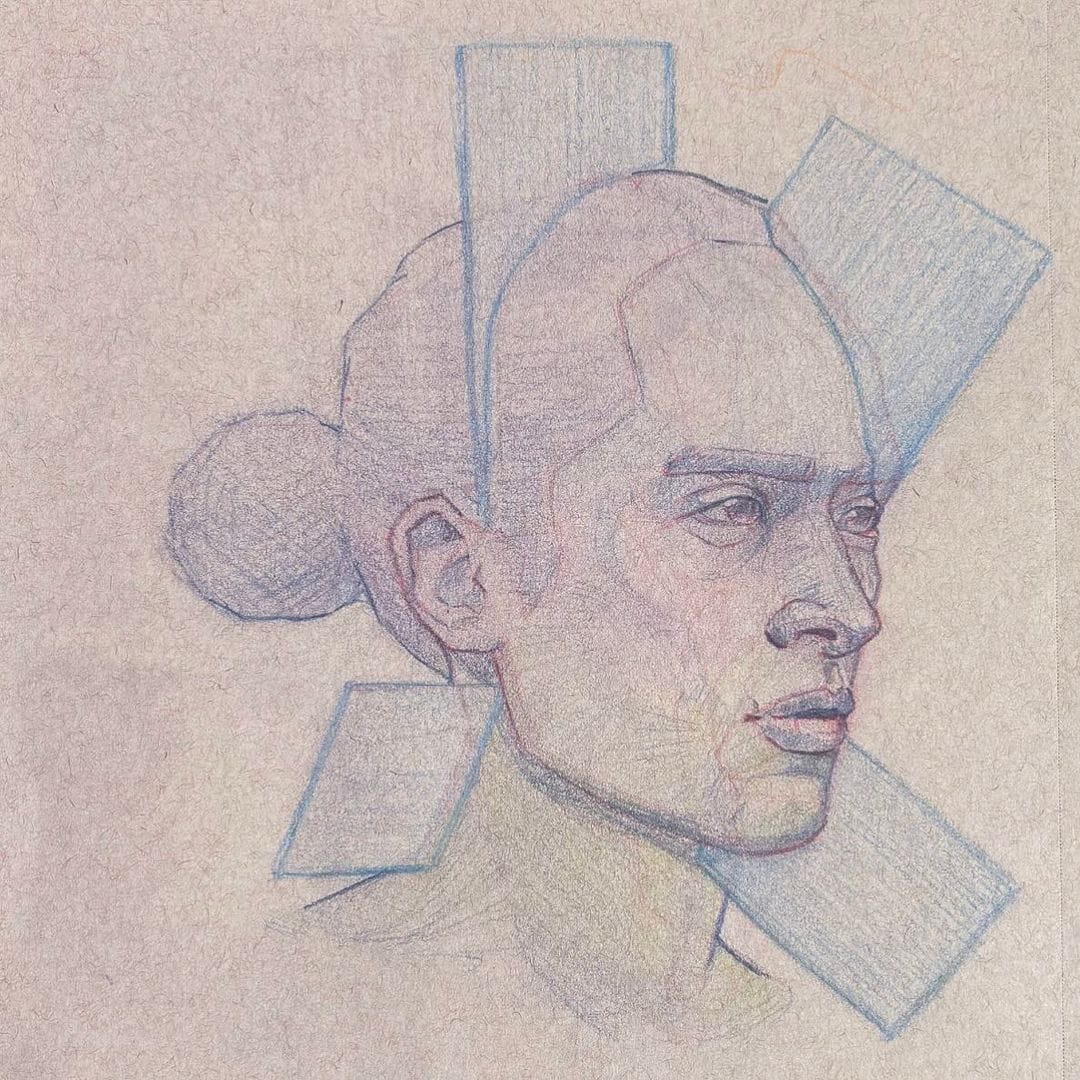
A portrait drawn while using the planes of the head to give it structure.
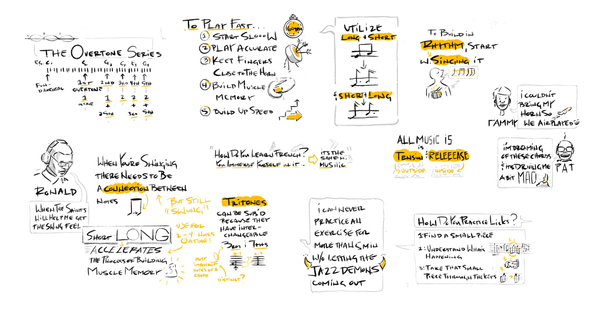
For the past 4 weeks I’ve been hammering my head on a jazz standard called Autumn Leaves. This tune is notorious for its back and forth movement between a major 2-5-1 and a minor 2-5-1. After a month of feeling like I was getting worse, I made a tiny change to my practice routine and - bam! - I had a mini breakthrough.
Instead of studying a bunch of different licks, I decided to keep it simple and just practice the harmonic minor over and over. And guess what? Even if im not playing face-melting solos, I can now elegantly improvise over Autumn Leaves. The surprising bit is that I notice I’m not just robotically playing up and down the harmonic minor scale - I’m now stepping “outside” of the safe notes of it more often. Its as if knowing I have this safety net to fall back on has made me more brave to wander away from it.
In child psychology, there is a concept called the secure base. Basically, it says that kids explore more if they have a “base”(aka a parent) to come back to. According to John Bowlby and Mary Ainsworth’s work on adult attachment styles, this idea extends to adults too. Since stumbling into this concept, I’ve wondered where else a sense of security might let us explore more.
In jazz you’ve got the jazz standard; a home that musicians riff off and come back to during a solo. In design it’s the design process which lets you ideate with wild abandon, while staying on course. In drawing, knowing human anatomy means you can stretch and bend figures, snapping back to key reference points as needed.
This relationship with security also seems like a big piece of creativity. When you know you’re ok to fail, you’re more likely to take risks. Stretch this idea to social safety nets and its clear, this same freedom to fail can become a privilege. In all of these cases, having stability is like having a boat we can count that lets us venture further out to sea than we might otherwise.
The secure base model also suggests that if we have a solid safety net early in life, we’ll carry that security with us later in life. Knowing our parents will love us regardless of how muddy our shoes get allows us to run around a greater sense of confidence once we leave home. At some point, we can have enough of that security inside of us that we can don’t need the same kind of outside support.
All of this makes me wonder: where else do we have hidden frameworks that we could clarify to boost our sense of security? How can we spread these frameworks so that others feel safe to explore? And how can we introduce them early enough so that the sense of security sticks?
To say nothing new, how can we make people feel more safe so that they can feel more free?
3 things I've learned about drawing and saxophone

- Sandwich sketch quizzes. I’ve been using a self-quizing technique my brother picked up from a book on learning and its pure magic. I start by drawing a skull from memory, then open a 3d skull reference to spot my mistakes. Afterwards, I close the reference and redraw the same skull from my mind. The last step, doing the thing without a reference, is always the most frustrating but the most valuable. Where else can a good quiz sandwich help us nail something down?
- Play the squeak. When I hit higher notes on my sax, I kept popping out these little mouse squeaks. After checking to make sure my horn wasn’t leaking, I got some bananas advice; instead of avoiding a squeak, try play it. Low and behold, after learning to squeak on purpose, avoiding it became easier. Wild. Where else could spending time with our squeaks help us steer clear of them?
- Long tones done right. Long tones are an anchor of sax practice, but I learned I was doing them wrong. Instead of just holding a note, here’s my new routine 1 - Take a proper belly breadth. 2 - Adjust until I hit a clean note. 3 - Hold it until I’m gasping for air. This exercise, is time and patience intensive but has massively improved my sound. I can’t help but groan thinking how fixing this 6 months ago couldn’t have saved me buckets of time. Where else do we make assumptions that could use a little sunlight and a nudge?
A quote I've been meditating on
“God enters through a wound”
-C.G. Jung
And a haiku I wrote
Love Is a pond frog.
Caught in the hands of a child.
Felt but never known.